Reveal
Potential
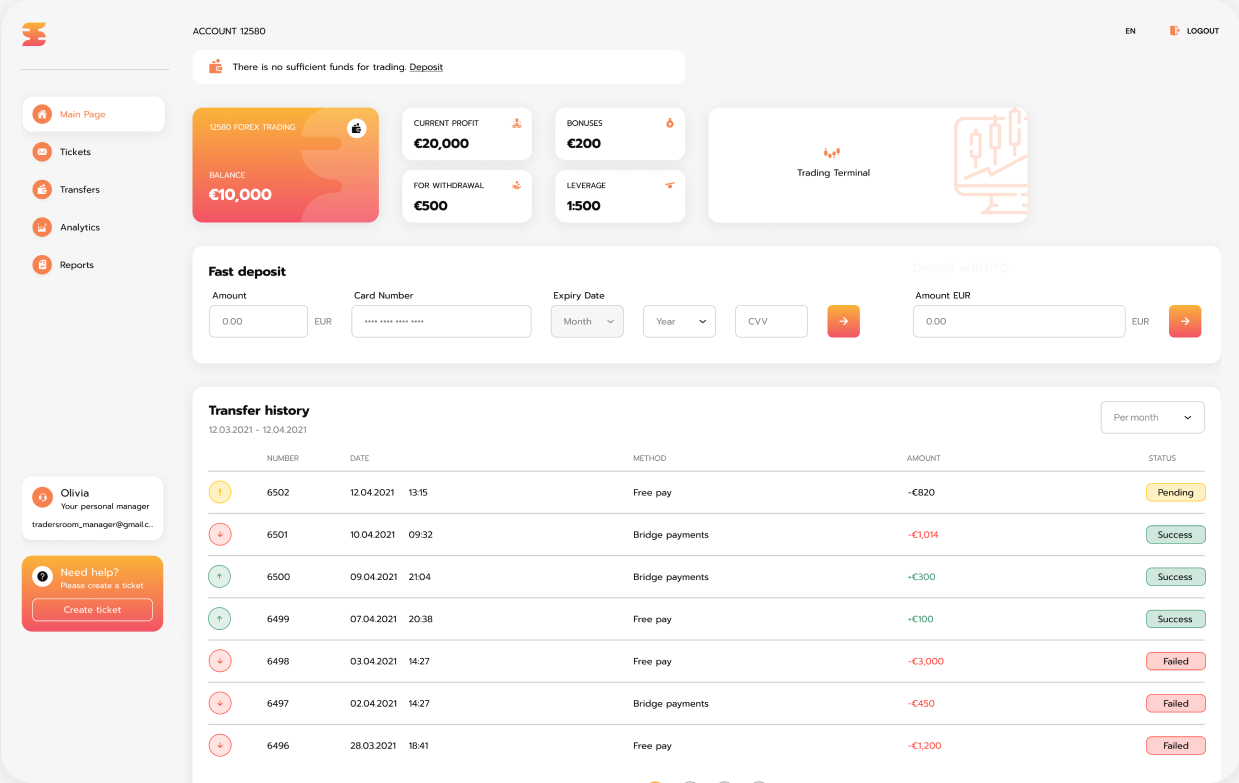
Reach the heights of trading with us! We offer a wide range of trading accounts suitable for traders of all levels.
Get Started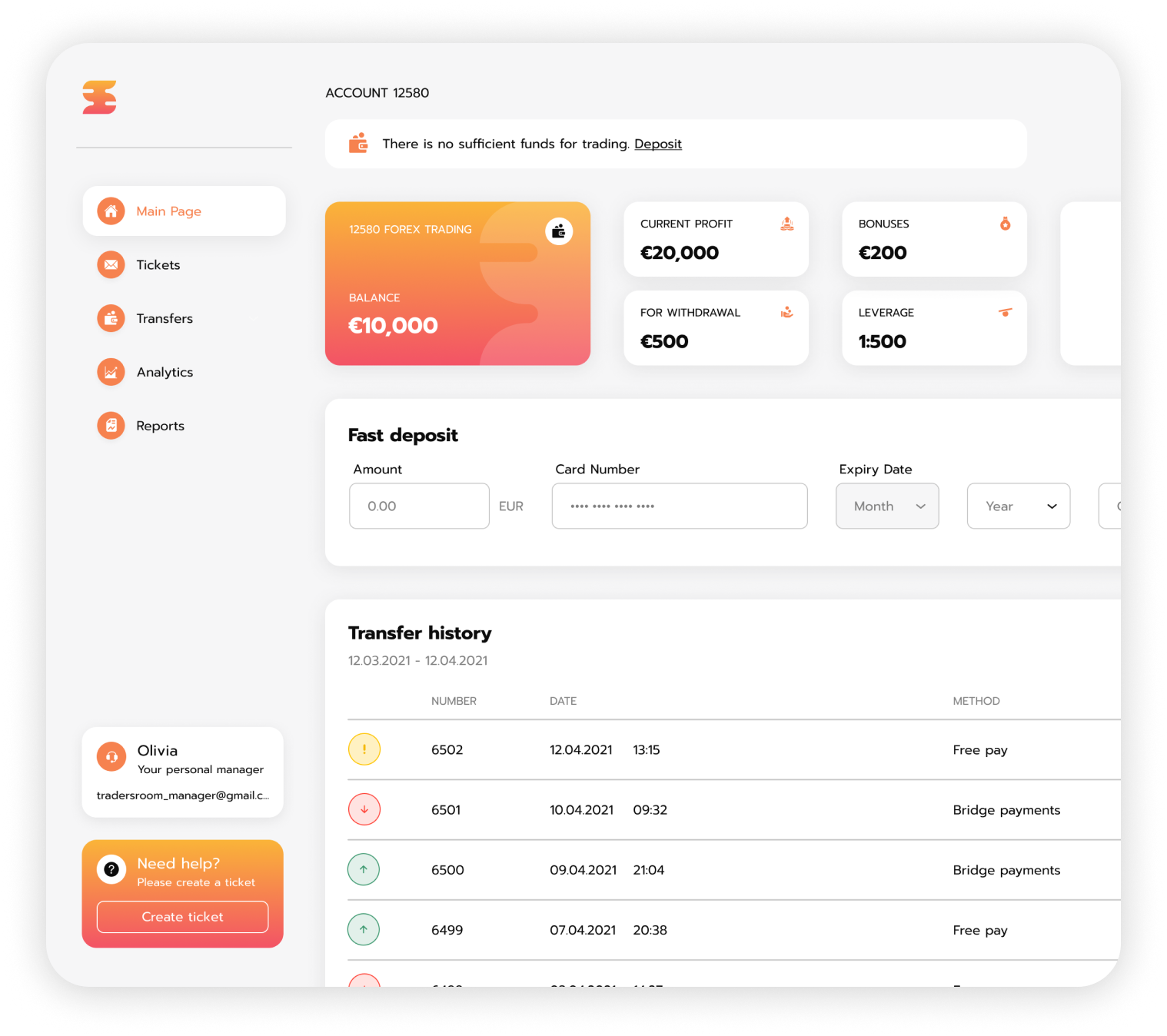
First steps
How to Start Earning
1step
Think
Consider several ways to earn money on the exchange. Assess their advantages and disadvantages. Choose among them the most suitable for you.
2step
Choose
Find several tools on our platform for investing and choose among them the most suitable one. Register and open a minimum deposit.
3step
Earn and Learn
Try different approaches, learn from your actions, gain experience. Analyze your steps, work on your mistakes, improve your skills and strategies.
Features
Open a World of New Financial Opportunities
Investments
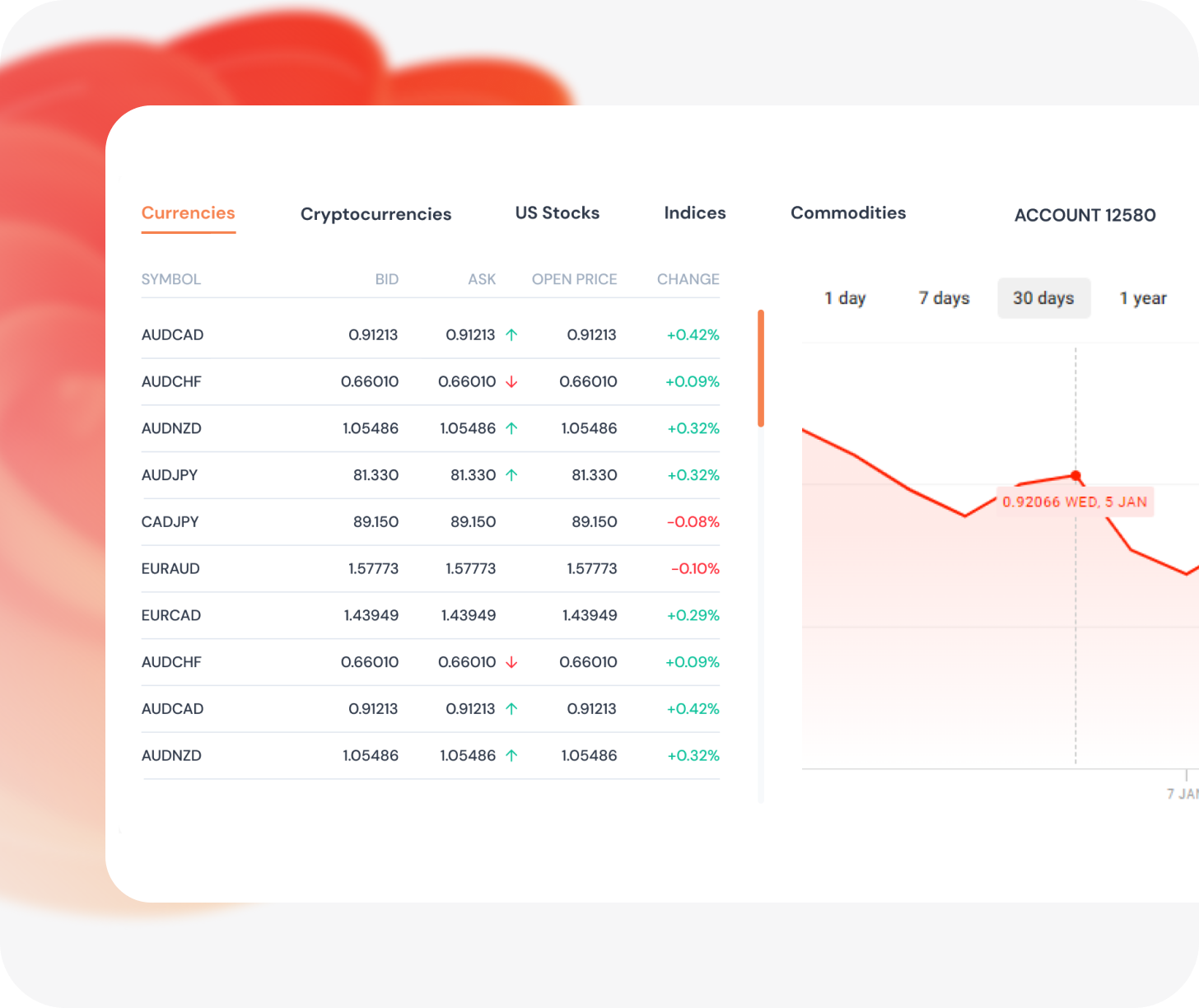
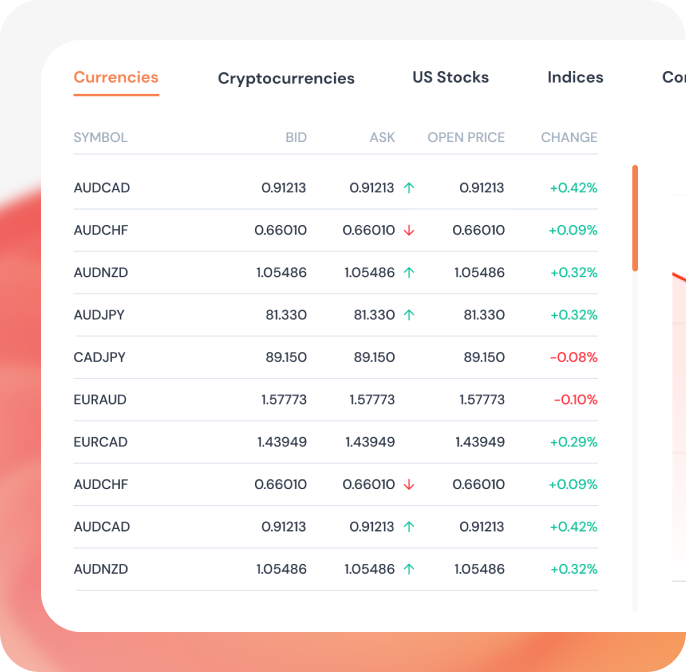
Explore a wide range of trading instruments, carefully selected for their high liquidity, allowing you to make optimal investment decisions.


Analytics
Gain access to exclusive market research empowering you to learn how to predict chart movements alongside our team of traders.


VIP Club
Join an international community of traders and unlock privileges that are typically unavailable to the majority of market participants.


Safety
The real-time margin calculation system reflects the market revaluation of all client positions, ensuring an accurate risk.


Explore a variety of options and trade with confidence, taking advantage of global market trends and making informed investment decisions.

Custom reports
Personalized Reports Customized for Your Needs
Every trader has unique requirements for analyzing and monitoring their trading activity. That's why our company provides customized reports specifically tailored to each client's needs. Our team of professionals works closely with traders to create personalized reports that highlight performance metrics, market analysis or visualization of specific data.
Personalized support
Comprehensive Support Service for Every Trader
Our company prioritizes effective communication with clients, providing a professional support service to address all financial inquiries related to trading. Our team of experts is always available to assist with any questions and ensure seamless trading experiences.



News
Stay Up to Date With the Trends and Happenings

11.09.2026
Zoomex launches ZWTC 2026 multi-asset trading championship
A Record-Breaking Prize Pool
Zoomex, a prominent global cryptocurrency derivatives exchange, has officially unveiled the Zoomex World Trading Championship 2026 (ZWTC 2026). Now in its third year, the event has evolved into the platform's flagship competition, boasting a massive total prize pool of up to 5,000,000 USDT—the largest in the history of the championship.
Expanded Multi-Asset Competition Format
The 2026 edition introduces a significant shift in strategy, moving beyond traditional crypto-only metrics to embrace a multi-asset approach. The competition is divided into three primary pillars: the Team Competition, the Solo Battle, and the Rewards Zone. This structure allows traders to engage with crypto perpetual contracts, stock-linked contracts, and AI-powered trading tools, reflecting Zoomex's commitment to diversifying its ecosystem while maintaining its derivatives-first identity.
Team Competition: Performance and Leadership
With a prize pool of up to 2,500,000 USDT, the Team Competition is designed to reward both individual trading prowess and community management. Teams will compete across three distinct leaderboards: Team ROI, Team Trading Volume, and the Most Popular Team. Team captains play a pivotal role in mobilizing their communities, with the potential to earn a 20% share of their team's rewards, while members benefit from collective performance rankings.
Solo Battle and AI Integration
The Solo Battle, featuring a 1,000,000 USDT prize pool, caters to independent traders. It is split into three categories: the AI Trading Battle, the Stock Contract Profit Leaderboard, and the Perpetual Contract Trading Volume Leaderboard. By integrating AI-assisted trading and stock contracts, Zoomex is providing traders with diverse environments to test their strategies against the top 100 participants in each category.
Accessibility Through the Rewards Zone
Recognizing that not all users wish to compete on high-stakes leaderboards, Zoomex has introduced the Rewards Zone with a 1,500,000 USDT prize pool. This section offers a lower barrier to entry, allowing users to earn rewards through daily check-ins, mission completion, friend referrals, and interactive activities like a Lucky Wheel and card collection games. Eligible users can potentially earn up to 10,000 USDT through these engagement-based activities.
Strategic Vision for 2026
Fernando Lillo, Marketing Director at Zoomex, emphasized that the championship is designed to mirror the evolving needs of modern traders. By blending derivatives with stock contracts and AI tools, Zoomex aims to create a comprehensive trading experience. The platform, which serves over 3 million users across 35 countries, continues to prioritize transparency and security, holding multiple regulatory licenses and maintaining rigorous Proof of Reserves standards to ensure a fair competitive environment for all participants.
21.08.2026
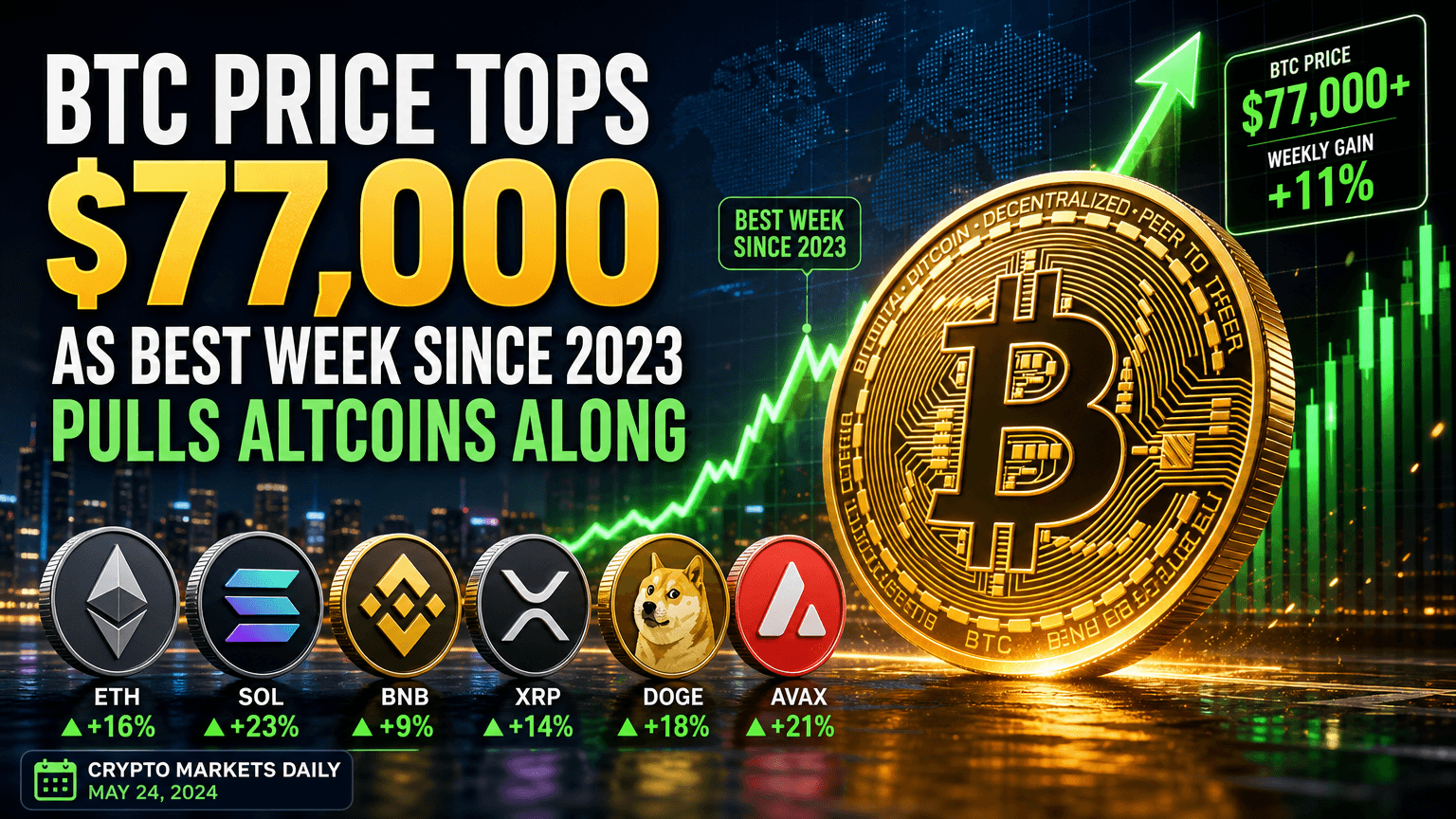
BTC price tops $77,000 as best week since 2023 pulls altcoins along: Crypto Markets Daily
Understanding the Current Bitcoin Rally and Derivatives Market Dynamics
The recent movements in the Bitcoin market have attracted significant attention, with derivatives positioning and rising open interest indicating a rebuilding of notional exposure. Additionally, spot demand metrics from CryptoQuant suggest that the current rally has the potential for further gains.
Bitcoin's Recent Price Surge
Bitcoin's price recently reached as high as $79,400, marking an impressive 8.8% increase since midnight UTC. This surge was part of a larger rally that began mid-week, spurred by an announcement from the U.S. Treasury. The cryptocurrency was trading just below $78,000 at the time of writing, showcasing continued strength in the market.
The Role of U.S. Treasury Actions
The U.S. Treasury's bond buyback announcement significantly contributed to Bitcoin's recent gains. The market reacted positively to this development, extending the cryptocurrency's upward momentum from earlier in the week. Over the course of five consecutive days, Bitcoin's price increased by nearly 24%, achieving its strongest weekly performance since March 2023.
Impact on the Derivatives Market
Bitcoin's price increase led to notable activity in the derivatives market. On Wednesday alone, $3.3 billion worth of derivatives positions were liquidated, with an additional $1.25 billion liquidated over the following 24 hours. This level of activity highlights the volatility and risk present in the derivatives market, where positions can rapidly change in response to underlying asset price movements.
Altcoin Market Dynamics
Despite Bitcoin's dominance reaching 59.9%, the Altcoin Season index fell to 33 from 36, indicating that Bitcoin's strength didn't necessarily signal weakness for other cryptocurrencies. For instance, ENA rose by 13% and ZEC by 12.5%, both outpacing Bitcoin's gains, while NEAR and LINK saw increases of around 8%. These movements suggest a healthy diversity within the cryptocurrency market, with some altcoins performing notably well.
Technical Analysis Insights
From a technical analysis perspective, Bitcoin's price surpassed the $76,000 level implied by an inverse head-and-shoulders pattern that began forming since June lows. Traders who capitalized on this breakout have reached their target projections, which could signal the potential for a short-term pullback. Additionally, the relative strength index (RSI) is currently in overbought territory, indicating that the asset may be due for a temporary correction before resuming its upward trajectory.
Conclusion and Future Outlook
In conclusion, Bitcoin's recent surge has been driven by a combination of positive market sentiment, significant announcements from the U.S. Treasury, and dynamic activity in the derivatives market. While the current rally shows promise for further gains, investors should remain vigilant for potential short-term corrections given the current technical indicators. As always, continuous monitoring of market trends and fundamental developments is key to successfully navigating the ever-changing landscape of cryptocurrency trading and investment.
19.08.2026
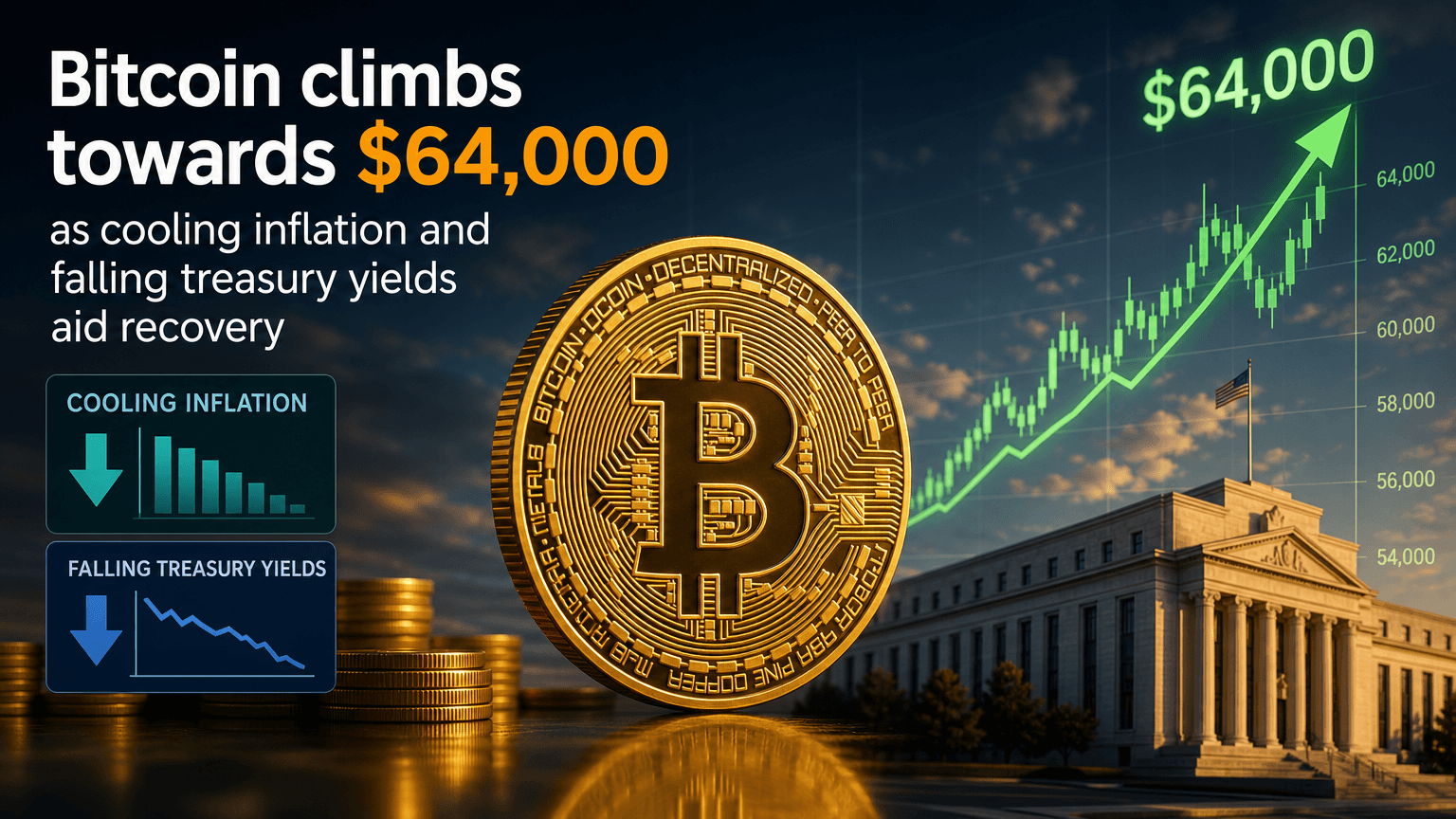
Bitcoin climbs towards $64,000 as cooling inflation and falling treasury yields aid recovery
Bitcoin Straddles the $64,000 Milestone: Analyzing the Market Dynamics
Bitcoin found stability near the $64,000 level as factors such as cooling inflation, decreased Treasury yields, and diminished expectations of further U.S. monetary tightening bolstered the cryptocurrency market. As a result, Ethereum and a selection of altcoins experienced gains, though analysts have voiced caution, indicating that the current rebound remains precarious. The financial community is now looking ahead to the release of FOMC minutes, upcoming inflation data, and labor market indicators, with $64,500 identified as a crucial resistance level for Bitcoin.
Current Market Situation
As of Tuesday, Bitcoin was trading close to the $64,000 threshold, specifically at around $64,246. This price movement has been supported by a combination of reduced U.S. monetary tightening expectations and favorable macroeconomic indicators such as cooling inflation and declining Treasury yields, which in turn cultivated a more supportive liquidity environment for digital assets.
Over the past 24 hours, Bitcoin saw a rise of 1.44% while Ethereum also edged up by 0.43% to trade at approximately $1899. Major altcoins like Solana, Tron, and Hyperliquid showed rallies of up to 1%, whereas BNB, XRP, Dogecoin, and Cardano experienced declines of up to 1.37%.
Market Insight and Investor Sentiment
Avinash Shekhar, Co-Founder & CEO of Pi42, observed that Bitcoin's approach towards the $64,000 mark signifies improving sentiment as the market digests a backdrop of potentially easing U.S. monetary policy, declining economic indicators, and lower Treasury yields, thereby creating more favorable conditions for digital assets.
Riya Sehgal, Research Analyst at Delta Exchange, noted that although the crypto market demonstrated recovery over the past 24 hours, the movement should be interpreted as a rebound rather than a confirmed trend reversal. Bitcoin ascended from the low-$63,000 range to around $64,500, and Ethereum progressed from $1,870 toward $1,915, until facing selling pressures.
Regulatory and Institutional Insights
The market’s focus is now shifting towards imminent U.S. regulatory discussions surrounding crypto industry leadership and the postponed CLARITY Act. Presently, $64,000 serves as a critical support level while $64,500 is considered immediate resistance. Nischal Shetty, Founder of WazirX, highlighted that the easing of U.S. policy expectations coupled with a weaker dollar enhances the crypto market outlook.
Shetty added that Bitcoin's resilience in the face of heightened oil prices and bond yields underscores continued investor demand. However, the recent moderation in institutional ETF activity, along with significant net outflows from U.S. spot Bitcoin funds, depicts a cautious market view.
Future Outlook and Investment Considerations
Prateek Gupta of Mudrex highlighted that Bitcoin's recent breakout from its $63,000 range, ascending past $64,000, is driven by changing macroeconomic conditions that are improving risk appetite. Expectations for a Federal Reserve rate hike in September have diminished, driven by weaker retail sales and indicators of a softer labor market.
According to Vikram Subburaj, CEO of Giottus, despite the price rebound, the on-chain dynamics remain cautious. Contracting spot volumes and transaction throughput signal weakened liquidity and limited market conviction. He advises investors to adopt strategies such as staggered accumulation, limited leverage, and disciplined position sizing until Bitcoin clears the $64,500-$66,000 range with stronger spot and sustained ETF demand.
(Disclaimer: Recommendations, suggestions, views, and opinions expressed by these experts are their own and do not necessarily reflect the views of The Economic Times.)
17.08.2026
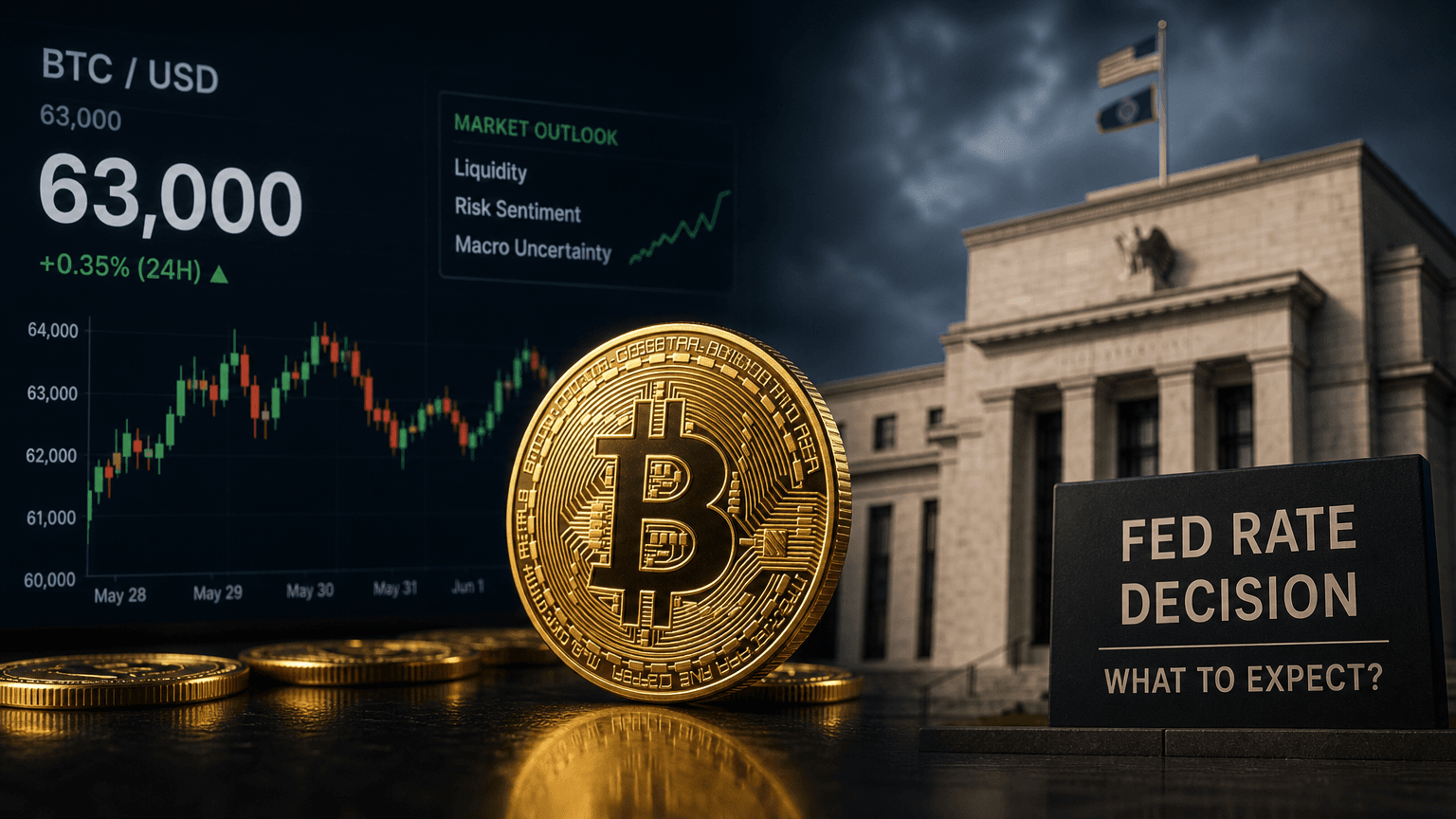
Bitcoin hovers near $63K ahead of Fed rate decision as investors assess liquidity outlook
Bitcoin and the Federal Reserve: A Delicate Balance
As Bitcoin hovered close to the $63,000 mark, market participants found themselves in anticipation of the Federal Reserve's latest guidance on interest rates. The significance of this cannot be understated as the Fed's decisions have far-reaching implications on market liquidity, the strength of the US dollar, and thereby on the appetite for riskier assets like Bitcoin. Currently trading around $63,336, Bitcoin's movements in the near term are likely to be heavily influenced by these macroeconomic cues. Analysts suggest that breaching the $63,300-$64,000 resistance could signal bullish momentum, while support at $62,300 provides a cushion against downward pressure.
Mixed Performance Across Cryptos
In the cryptocurrency market, divergence in performance was noted among major assets. Bitcoin and Ethereum saw minor increases of 0.53% and 0.75% respectively over the past 24 hours. Some altcoins like Tron and Hyperliquid experienced rallies up to 2.81%, buoying market sentiment. Conversely, BNB, XRP, Solana, and Cardano faced declines of up to 1.48%. These mixed performances reflect broader consolidation phases within the market.
ETF Flows and Geopolitical Influences
The broader market dynamics were shaped by several factors including weaker Bitcoin ETF flows and geopolitical tensions, especially in the Middle East. The CoinSwitch Markets Desk emphasized that these elements pose substantial risks and could potentially discourage risk-taking behaviors among investors. $390 million in net outflows from US spot Bitcoin ETFs underscored a shift in institutional sentiment, reversing the $865 million inflows recorded in the previous week.
Market Consolidation and the Road Ahead
Riya Sehgal of Delta Exchange provided insight into the consolidated state of crypto markets. As Bitcoin hovers around $63,200 and Ethereum near $1,895, market participants aim to gauge the impact of macroeconomic factors, like the FOMC minutes release. Such events could sway markets, particularly if monetary policy tightens, applying additional pressure on risk assets.
Experts Weigh In
Comments from industry experts provide additional context. Nischal Shetty, founder of WazirX, pointed to the bearish technical setup for Bitcoin, with moving averages indicating a seller's market. A breach of $64,000 could counter this bearish narrative, easing downside pressures for futures traders. Meanwhile, Vikram Subburaj from Giottus observed low spot trading volumes, hinting at market indecisiveness with neither buyers nor sellers commanding enough influence to drive significant market moves.
The Importance of Patience in Volatile Times
Avinash Shekhar of Pi42 suggested that current market conditions warrant patience over aggressive positioning, highlighting the importance of Bitcoin maintaining levels above $62,300 to ensure momentum. For Ethereum, surpassing the $1,900 to $2,000 price range could demarcate a clearer trajectory.
As the crypto market navigates these uncertain waters, the expert consensus underscores a cautious yet watchful approach, acknowledging that pivotal thresholds in both price levels and regulatory developments will likely dictate the path forward.
(Disclaimer: Recommendations, suggestions, views, and opinions given by the experts are their own. These do not represent the views of The Economic Times.)
Want to Be a Part of a New Trading World?
Simply provide us with your email, and our manager will contact you to get started.