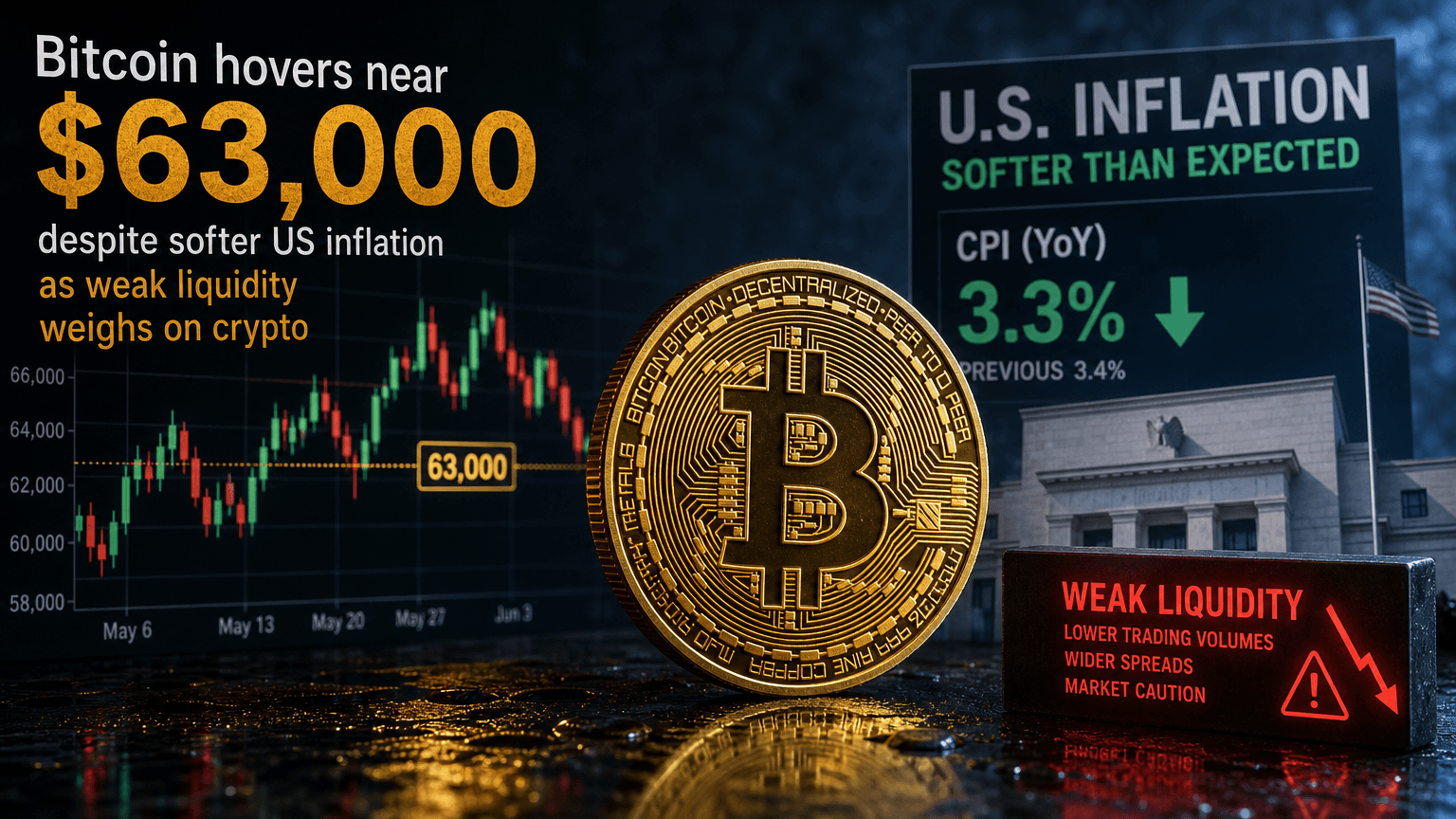
Bitcoin hovers near $63,000 despite softer US inflation as weak liquidity weighs on crypto
Current State of Bitcoin and Major Cryptocurrencies
Bitcoin prices have stabilized near the $63,000 mark amid a backdrop of weak liquidity and subdued institutional demand, counterbalancing recent softer U.S. inflation data. On Friday, Bitcoin was trading at approximately $62,847, reflecting a modest decline of 1.31% over the past 24 hours. Ethereum similarly experienced a downturn, decreasing by 0.70%. Major altcoins such as BNB, XRP, Solana, Tron, Hyperliquid, Dogecoin, and Cardano also witnessed declines, with some coins falling as much as 1.89%.
Market Liquidity and Institutional Sentiment
The lackluster response in the crypto market can be attributed to weaker market liquidity. Prateek Gupta, Head of Business at Mudrex, pointed out that the daily spot Bitcoin volume has plummeted to $1.19 billion—a six-year low—compared to a peak of $14.7 billion in February. This decline is coupled with substantial outflows from Bitcoin ETFs, exceeding $200 million over the past week, suggesting cautious sentiment among institutional investors and limiting short-term upside potential.
Global Crypto Market Capitalization
The global cryptocurrency market capitalization has edged down by 1.29% to $2.16 trillion, according to CoinMarketCap. After the recent market correction, Bitcoin is struggling to maintain support at the $63,000 level, with resistance from bearish forces preventing the cryptocurrency from breaking above $64,000, as noted by CoinDCX Research Team.
Macroeconomic Factors and Market Divergence
Despite a macroeconomic landscape that includes softer U.S. producer inflation, which has alleviated near-term interest rate concerns, the crypto markets remain inherently cautious. Riya Sehgal, a Research Analyst at Delta Exchange, noted the muted response within the crypto space despite these potentially positive developments. Bitcoin continues to trade near $63,500, while Ethereum hovers around $1,890, signaling limited fresh spot demand. ETF flows further contribute to market divergence, with the U.S. spot Bitcoin ETFs recording around $125.4 million in net outflows, while Ethereum ETFs managed a modest net inflow of $6.5 million on August 13.
Institutional Flows and Market Outlook
Vikas Gupta, Country Manager of Bybit, highlighted that institutional flows have shown inconsistency. For instance, U.S. spot Bitcoin ETFs witnessed a $144.6 million outflow on August 10, followed by a mere $7.8 million inflow on August 11. Despite previous consecutive sessions of inflows earlier in August, these flows remain highly reactive to macroeconomic conditions, indicating an inconsistent demand from institutional players.
Technical Analysis and Price Levels
The market outlook, as analyzed by various experts, suggests specific support and resistance levels crucial for price movements. According to Nischal Shetty, Founder of WazirX, futures traders need to watch the downside zone around 0.0134-0.0132, with further support at 0.0130-0.0124. The CoinSwitch Markets Desk observes that Bitcoin's immediate upside targets include reclaiming the $64,000-$64,150 range, with potential subsequent resistance at $64,500 and $65,000 levels. Vikram Subburaj, CEO of Giottus, identifies immediate support at $62,800-$63,000, with resistance around $63,900-$64,000 and a more formidable ceiling at the $65,000-$66,000 range. Avinash Shekhar, Co-Founder & CEO of Pi42, believes the ongoing consolidation of Bitcoin around $63,000 to $64,000, amidst declining spot volumes and ETF outflows, signals restrained market conviction.
Conclusion
In conclusion, Bitcoin and the broader cryptocurrency market face a challenging landscape defined by weak liquidity, inconsistent institutional flows, and a divergent response to macroeconomic factors. The near-term outlook remains cautious as traders and investors navigate through these complex market dynamics. Continuous monitoring of key price levels and institutional fund flows will be critical to understanding future market trajectory and volatility.
14.08.2026